


Someone I know was talking about Norman Rockwell and his paintings of dogs, so I went looking through his work. I ended up somewhere else entirely, on his wartime stuff, and I stopped on one of a skinny kid in a blue uniform and a soft round hat, hemmed in on all sides by bigger men, clutching a package and cutting his eyes sideways like he’s already in trouble.
It was Gilligan. Not literally, obviously. But my brain said Gilligan before it said anything else.
Then I read the caption.
The character’s name is Willie Gillis.
Gilligan’s full name, in Sherwood Schwartz’s original material for the show, was Willy Gilligan.
I’ve spent a while trying to find someone who has already written this up, and as far as I can tell nobody has. So here it is. I want to be upfront that this is a fun one and not a takedown, but I also think there’s probably something real underneath it. Just not the thing you’d assume.
Norman Rockwell created Willie Gillis in 1940, as the draft was ramping up and the war in Europe was getting worse. Gillis first showed up on the cover of The Saturday Evening Post on October 4, 1941, carrying a package labeled FOOD while half a dozen bigger soldiers crowded in behind him. The package is addressed to Pvt. Willie Gillis Jr. He went on to appear on eleven Post covers, the last one in 1946.
He was a private, and he stayed a private. Rockwell tracked him from induction all the way through discharge and never once painted him in combat. Rockwell described him as “an inoffensive, ordinary little guy thrown into the chaos of war,” which is about as good a one-sentence character summary as anyone’s ever written.
He also wasn’t obscure. The Post had something like four million subscribers at the time, and enough readers thought Willie Gillis was a real person that the magazine got piles of mail asking how he was doing. Families with the last name Gillis were especially invested.
One more thing worth knowing, because it matters later. Rockwell didn’t come up with the name himself. His wife did, and she got it from the old nursery rhyme Wee Willie Winkie.
Hold onto that.
Sherwood Schwartz has said he found the name Gilligan by going through a Los Angeles telephone directory. That’s the standard story and I have no reason to doubt it.
But notice what that story actually explains. It explains Gilligan. It doesn’t explain Willy Gilligan.
And I should be honest here, because this is the soft spot in the whole thing. The “Willy” part is real but it’s messier than most trivia posts make it sound. Snopes dug into this years ago and found that the name appears in early conceptual material for the show, in print, so Schwartz clearly considered it. TV Guide turned it up in an old press release back in 1993. Schwartz himself said in his book Inside Gilligan’s Island that he and Bob Denver argued about it for decades:
Denver’s version was that “Willie” was just something the two of them landed on in conversation, in case the character ever needed a first name. And confusing things further, Schwartz elsewhere explained that he deliberately gave the castaways first names or nicknames only, the Howells being the exception, which would make Gilligan a first name and rule out Willy Gilligan entirely.
So the man contradicted himself. That’s fine. It doesn’t wreck anything. What survives all of it is that at some point during development, the words Willy Gilligan got typed onto a page by Sherwood Schwartz. Say them next to each other.
Willie Gillis. Willy Gilligan.
Same first name, same first two syllables of the surname, nearly the same rhythm. That’s not a resemblance you have to squint at.
Schwartz was born in November 1916, so he was 24 when Willie Gillis first showed up on newsstands. He was already a working comedy writer by then. He’d started writing jokes for Bob Hope’s radio show in 1939.
And then this, which is the part I’d underline if I were only allowed to underline one thing:
Sherwood Schwartz spent over four years in the United States Army, writing for the Armed Forces Radio Network.
So he didn’t just live through the war the way everyone did. He spent it as a soldier whose actual job was writing entertainment for other soldiers. Figuring out what the average GI found funny was his day job, for four years, at the exact moment when the most famous painted GI in the country was a skinny private named Willie Gillis on the cover of a magazine four million people got in the mail.
I’m not claiming he was a Rockwell scholar. I’m saying that not encountering Willie Gillis would have taken real effort on his part.
This is the part that got me in the first place, and it’s worth being specific about, because I nearly talked myself out of it.
Willie Gillis on that first cover is not in dress uniform. He’s in the Army’s blue denim work uniform, the M1937/M1940 fatigues the Army issued before switching over to olive drab herringbone twill during the war. Denim jacket, matching denim trousers, cuffs rolled up because they’re too long for him.
And on his head is the blue denim fatigue hat. Soft crown, floppy round brim, no structure to it at all. Soldiers called it the Daisy Mae, after the Li’l Abner character.
It is a bucket hat. It is, in silhouette, Gilligan’s hat.
Different color, obviously. Gilligan’s is white and Willie’s is indigo. But the shape is the same shape: the soft round brim that flops down and makes whoever’s under it look about twelve years old. On both of them it does exactly the same work. It’s the thing that tells you this guy is not in charge of anything.
Now look at the rest of the composition. Willie is the smallest person on the cover by a wide margin. Six larger men are pressed in around him and they all outrank him. His trousers are cuffed. His eyes are cut off to the side. He is holding his package the way you hold something you expect to have taken away from you.
Put that next to Bob Denver in a red shirt and a white bucket hat, standing next to the Skipper, and tell me your brain doesn’t do the same thing mine did.
The model for Willie Gillis was a Vermont kid named Robert Buck. Rockwell spotted him at a square dance in Arlington and stared at him so long that Buck told him he was about to get knocked flat. He was fifteen at the time, five foot four, with a piece of hair that fell down over his forehead.
That’s the Gilligan build. That’s the whole physical joke of the character, a small guy in a uniform that’s wearing him instead of the other way around.
Then in 1943, Buck enlisted. He’d been exempt from the draft and signed up anyway.
He joined the Navy, and spent the war in the South Seas.
I want to be clear that this proves nothing whatsoever. It’s just a hell of a coincidence and I’m not going to pretend I didn’t enjoy it.
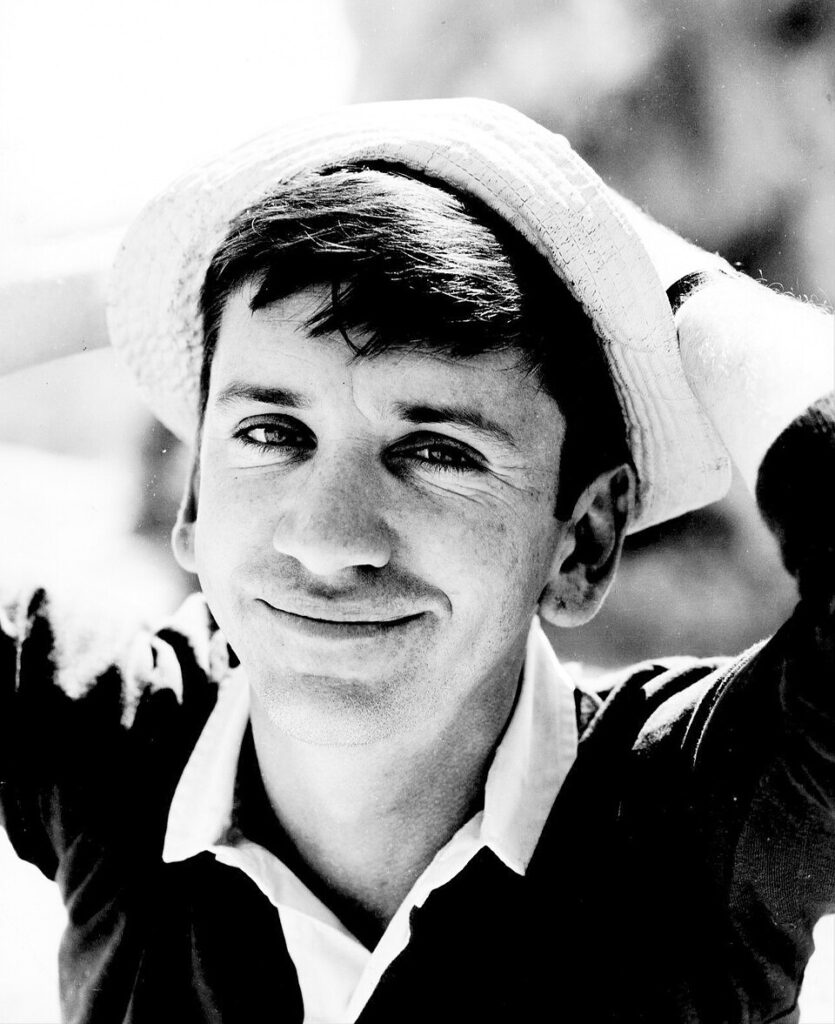
Bob Denver as Gilligan.
Not a secret tribute. I don’t think Schwartz sat there in 1963 thinking about Norman Rockwell.
There’s a term for what I suspect, and it’s called cryptomnesia. It’s when something you encountered years ago resurfaces as an original thought, with the memory of where it came from stripped off. Musicians run into this constantly and occasionally get sued over it. It isn’t lying and it isn’t theft. Your brain just hands you something that feels new.
Here’s the version that makes sense to me. Schwartz needs a name for a young sailor who is decent, useless, and permanently in over his head. He goes through the phone book, which is a normal thing writers do, and Gilligan jumps out at him. It sounds right, and he doesn’t examine why it sounds right. Then a first name arrives more or less on its own, and it’s Willy, and that also sounds right.
Twenty-some years earlier he’d spent a war looking at magazine covers of a decent, useless, permanently overwhelmed private named Willie Gillis.
Both of those things can be completely true at the same time. He can have found Gilligan in the phone book and still have been steered toward it, and toward Willy, by something he’d stopped being able to locate. That’s not a conspiracy. That’s just how memory works.
The original series treatment even had Gilligan as an ex-Navy cook who knew nothing about boats and talked his way into the job because he needed the work. An ordinary guy in a uniform he hadn’t really earned. Rockwell would have recognized him.
Since I’d rather this not get quoted back at me in ten years as established fact, here’s the honest ledger.
Documented: Rockwell created Willie Gillis, who debuted on the October 4, 1941 Post cover and appeared on eleven covers through 1946. Documented: the name came from Rockwell’s wife by way of Wee Willie Winkie. Documented: on that first cover he’s wearing Army blue denim fatigues and a Daisy Mae bucket hat, which you can go look at yourself. Documented: Schwartz was 24 in October 1941, and spent over four years in the Army writing for Armed Forces Radio. Documented: early Gilligan’s Island material used the name Willy Gilligan, and Schwartz defended it in print in 1988. Documented: Schwartz said he found Gilligan in a phone book.
Not documented, and this is the important one: there is no interview, memoir, production note, or credible source anywhere in which Schwartz mentions Willie Gillis. None. I looked. If it exists I’d love to see it.
So no, I can’t tell you that Norman Rockwell named Gilligan.
Two of the most recognizable everymen in American pop culture, made twenty-three years apart by two men who spent their careers on exactly this kind of character. Both of them small, decent, in uniform, and constantly making things worse. Both of them under a floppy bucket hat. Both named some version of Willy Gilli-.
And both names, when you chase them down, came from somewhere completely mundane. A nursery rhyme. A phone book. Nobody sat down and invented either one.
Which is either the funniest part of this or the most convincing part, and I honestly can’t decide which.
Coincidence?
Probably.